 Ember
EmberWind finally swung NW this morning — first mature buck on the trail cam all season. Anybody else seeing movement pick up with this cold front?
❤ 4712 commentsShare
DMDana M.Same over here. Grunt call working better than the bleat this week.
The whole safety net, line by line: what fires, who gets told, and what we keep. Every line is stamped with whether it’s in the app today or still coming, so nothing here is a promise dressed up as a feature.
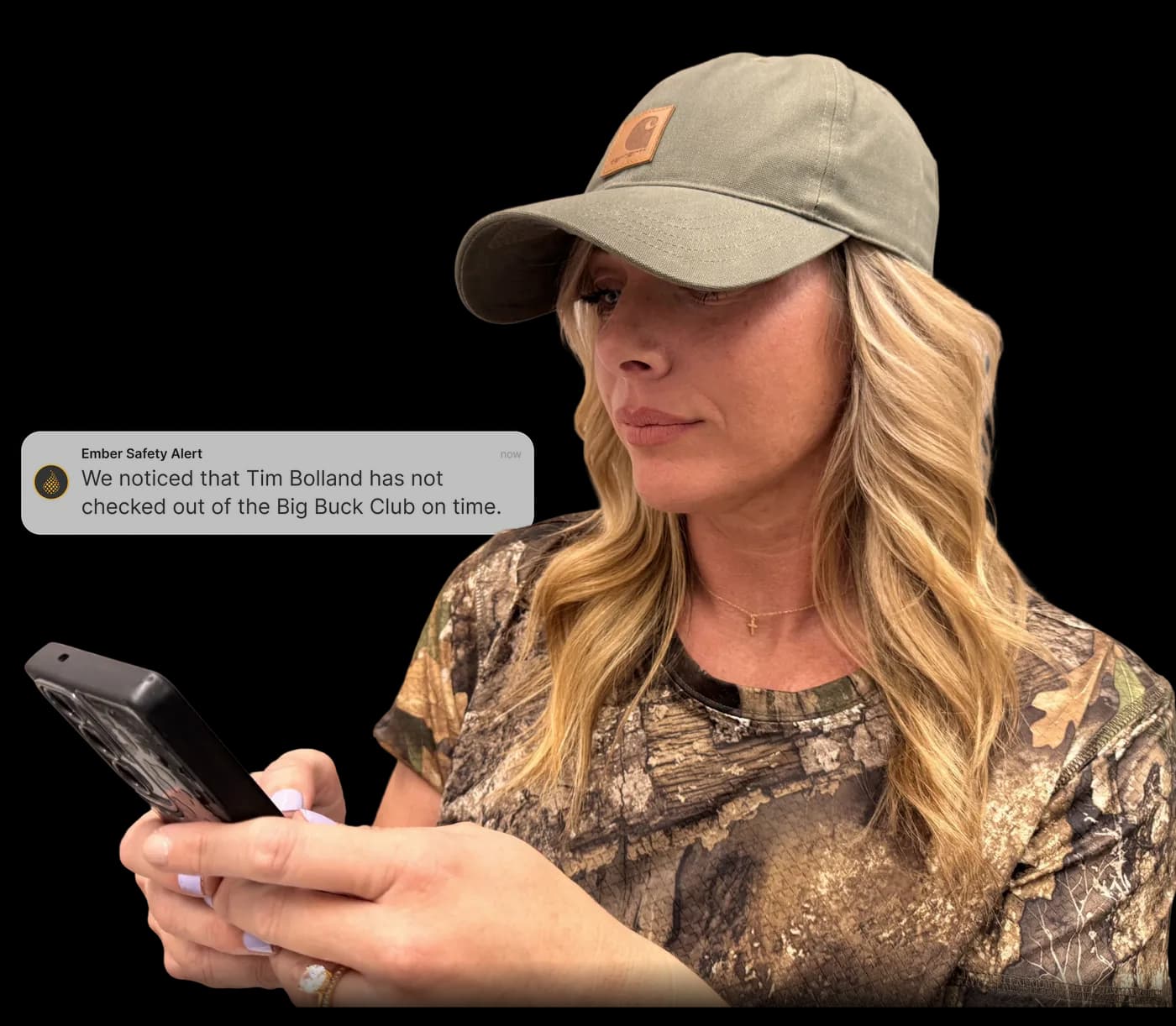
If you don’t check out after a hunt, Ember escalates automatically: a push to you first, then a text and an automated call, then voice calls to your emergency contacts and a push to your club’s admins. SOS calls and texts your contacts in one tap. The whole chain is free on every plan, with one emergency contact (Pro: three).


Stand falls get the attention, and they should: most of them happen in the evening, on the way down.2 But the calls that strand hunters are just as often the ordinary kind. Any of them, alone and out of signal, becomes an emergency. Here is what the record says.
of emergency-room visits for hunting-stand injuries were falls, in a six-year national sample: about 6,400 visits a year.
of those visits was a strain or sprain, not a fracture. A rolled ankle twenty feet up is still a rescue.
hunters in a cardiac study pushed past 85% of their maximum heart rate while deer hunting. Several showed heart strain on the monitor.
is how long someone hanging in a harness may stay conscious, per OSHA. A timer that fires an hour later is too late. That is what SOS is for.
of rural Americans had no baseline 5G coverage where they live as of late 2022. Your alert has to wait for a bar, then send.
of Maine’s searches are resolved within twelve hours. The Warden Service credits phone location data for shortening rescues.
No hunter-specific figure exists for dehydration or heat illness, so we name them and don’t put a number on them. We also left out the widely repeated “300 to 500 stand-fall deaths a year” and “1 in 3 hunters will fall” because neither traces to a primary source.
Check in on the walk to the stand, check out on the way home. Your crew sets a checkout time, 8:00 PM out of the box. Past it with no check-out, Ember escalates on the schedule below, with nothing left to memory.
The first nudge goes to you, not your family. Most misses are a hunter who forgot to tap out.
Are you still out there? You are past your checkout time. Open Ember to check out or extend your hunt.
If the push didn’t land, your phone gets a text and an automated call.
Jesse, you are past the checkout time for Blackhills Lease. Open Ember to check out or extend your hunt.
Every contact you named gets a voice call, word for word as shown on the right. The crew’s owners and admins get a push saying you missed checkout and haven’t responded.
On the hour. Ember runs this check once an hour, so a step can fire up to an hour after the offset shown. Set your checkout time with that in mind.
Hunting alone? Make a group of one. The ladder is identical, and the people it calls are whoever you named.
Down in a hollow? Check-ins and check-outs queue on your phone and send the moment it finds a bar. Your checkout time doesn’t move; the check-in is stamped with the moment you tapped it, not the moment it sent.
Checkout time was 8:00p. Checked in at Stand 2-1.
Hello Dana Miller. This is an automated safety alert from Ember. Jesse Miller has not checked out from Blackhills Lease by their hunting club’s checkout deadline. Please try to reach them directly. If you cannot reach them and believe they may need help, consider contacting local authorities. Goodbye.
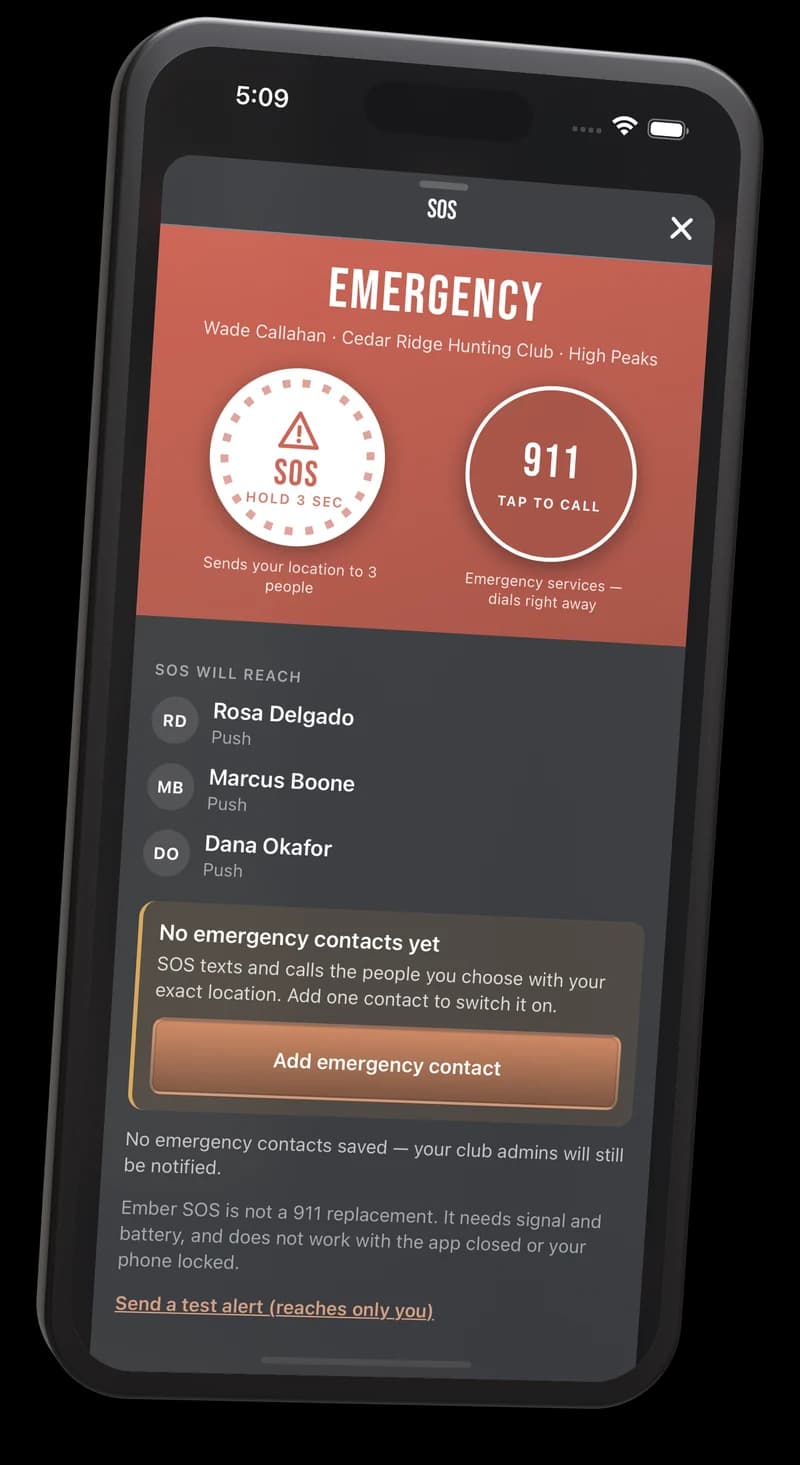
A fall, chest pain, a bad cut: you don’t want a ladder, you want everyone now. SOS is one tap, and it works with or without a crew.
Ember tries for a live GPS fix for eight seconds. Failing that it uses your phone’s last fix, then the stand you checked into, then where your hunt session started, and it says which one it used. It never calls a stale spot “current.”
Every contact you named gets an automated voice call and the text shown here. Both, because a text can be filtered and a ringing phone can’t.
The crew’s owners and admins, plus anyone checked in on the same property, are told. They can tap “I’m responding,” and you see who’s coming and how many were reached.
The alert waits on your phone and retries for 24 hours. After a minute stuck, Ember offers to send a plain text instead.
A test SOS goes only to your own phone, with the exact words a real one would use. Try it before opening day so nobody at home meets it cold.
Location is the data we guard hardest. The rule is short: your position leaves your phone only when you ask for help or log something yourself, and an alert’s position goes only to the people coming to get you.
No dates yet, and we won’t invent one. Until they ship, neither is on the ledger as done.
You don’t need the app, an account, or a club to be on the list. If your hunter names you as an emergency contact, yours is the phone that rings, at the hour and in the words shown above. The family page walks through what you’ll see and when, from your side of it.
Know they made it out
How do other crews run check-ins, and who do they name as contacts? Trade notes with other hunters in the Ember Hunt Camp on Facebook.
The whole safety chain — check-in, location sharing, SOS, auto sign-out, and the missed-checkout escalation — ships free with every account, solo hunter or fifty-member club, no card required. Free includes one emergency contact; Pro raises that to three.

Plans are purchased in the app, billed by the App Store or Google Play. The full safety chain — check-in, SOS, location sharing, and missed-checkout alerts — is free for everyone. See full pricing for what each plan includes.
Check in on the walk to the stand, check out on the way home. Your crew sets a checkout time — 8:00 PM out of the box, and a solo hunter is a crew of one. Past it with no check-out, Ember escalates: a push to you, then a text and an automated call to you, then a voice call to your emergency contacts and a push to your crew’s admins. It checks once an hour, so each step can fire up to an hour after its offset.
SOS is one tap and works with or without a crew. Ember tries for a live GPS fix for eight seconds, then falls back to your last fix, the stand you checked into, or where your hunt session started. Every emergency contact you named gets an automated voice call and a text, and the alert retries for 24 hours.
No. The whole safety chain — check-in, location sharing, SOS, auto sign-out, and the missed-checkout escalation — ships free with every account, solo hunter or fifty-member club, no card required. Free includes one emergency contact; Pro raises that to three.
The whole safety chain is free for everyone, including the automated alerts that ring a real phone. Pro adds the Breakdown, the maps, and more emergency contacts — $99.99 a year, 14 days free.
Every line on this page was checked against the app on September 7, 2026.